 Bristora

Why the certificate is the factory’s, not ours
A certificate always belongs to the entity that was audited. An ISO 9001 quality system, a BSCI social audit or a SEDEX/SMETA assessment is issued to a specific legal entity operating a specific site, and that entity is a factory, not a sourcing company.
This matters to you as a buyer for two practical reasons:
- If a sourcing company presents factory certificates as its own, the claim can’t survive verification. Look up the certificate number with the issuing body and the registered name won’t match the company in front of you. That isn’t a technicality: it’s a signal about how the supplier treats claims in general.
- What you actually need is a certificate that covers the factory making your order, and is current. A valid certificate for a factory that isn’t producing your brushes, or one that expired last year, protects no one.
Our position is therefore simple to state and simple to check: the certificates are held by our partner factories, and our compliance desk verifies them directly with the issuing bodies every audit cycle. What we put on the table is the verified copy tied to your order, plus the audit trail behind it.
Company-level qualifications we do hold
| Qualification | Scope | Verification |
|---|---|---|
| Business license | Registered scope covering sourcing, trading and export of beauty tools | Unified social credit code shared during RFQ; verifiable on the national enterprise registry |
| Export operation qualifications | China customs registration and export eligibility (import/export rights) | Customs registration number verifiable via customs records |
These are our own documents and we will send them with any quote on request. They establish that we’re a real, export-qualified trading entity: they don’t, and should not, claim to be factory certifications.
Partner-factory certifications (verified, not borrowed)
Factory-level certifications in our network, and how we handle each one:
| Certification | What it covers | How we handle it |
|---|---|---|
| ISO 9001:2015 | Quality management system at the factory level | Certificate number checked with the issuing body; expiry tracked so expired certificates are never presented |
| BSCI | Social compliance audit: labor conditions, working hours, safety | Audit report and grade shared for the factory running your order, factory identity disclosed under NDA |
| SEDEX / SMETA | Alternative social audit framework, widely recognized by EU and UK retailers | Same treatment: report obtained for the specific factory and site |
| FSC | Chain-of-custody for wooden and bamboo handle materials | Certificate number verified with FSC; applies to the handle supplier, not the assembly site |
Authenticity is checked with the issuer, not the photocopy. During every audit cycle we look up certificate numbers directly with the issuing body and re-confirm the registered entity name, site address and validity dates. A factory presenting an expired certificate, or one registered to a different legal entity, fails admission: this is one of the document checks that most often removes a candidate from the network.
For orders where certification is a condition of your own retail or distributor agreement, tell us at RFQ stage. We route the order to a certified factory and supply the report tied to that specific site, which is what your buyer or retailer will ask for.
The documents themselves
Three of the documents behind that table, published as issued. The holder name is pixelated on purpose: the same rule as our factory list: we show the standard, the scope and the dates, and we share the holder under NDA during RFQ. The test report behind the CE declaration carries the number ST20260512006-1, dated 20 May 2026 and issued by STAR-TECH (Shenzhen) Co., Ltd. That is the number to quote if your compliance file has to trace the RoHS testing back to a file.
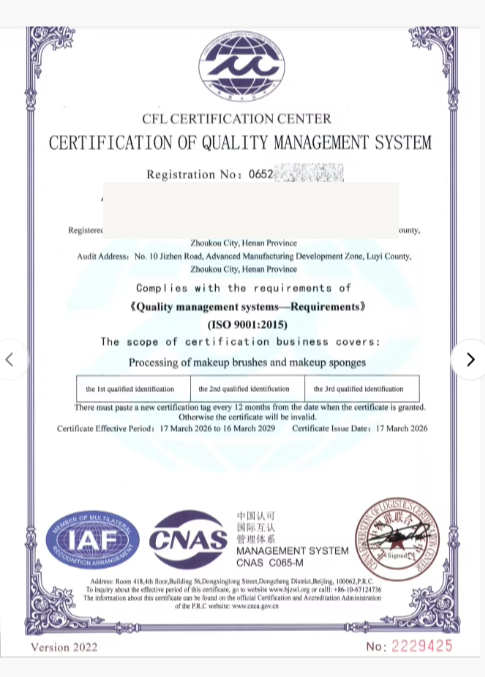
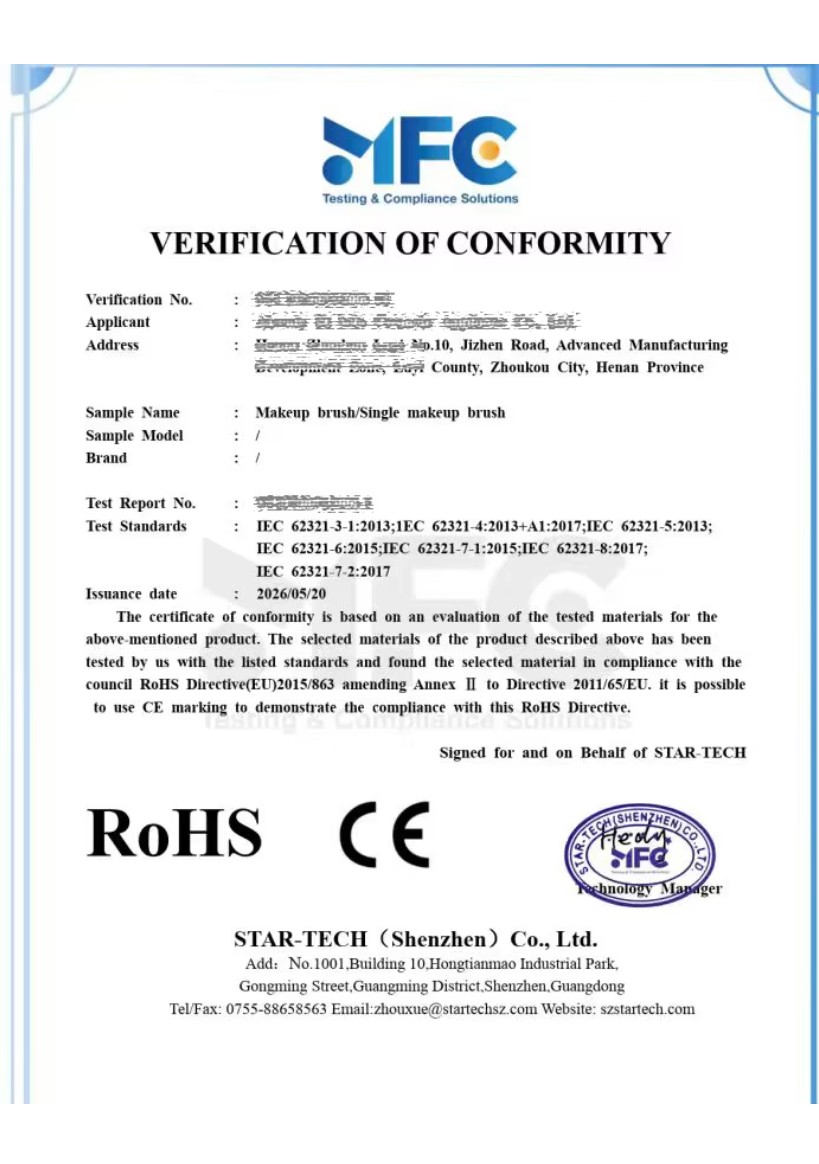
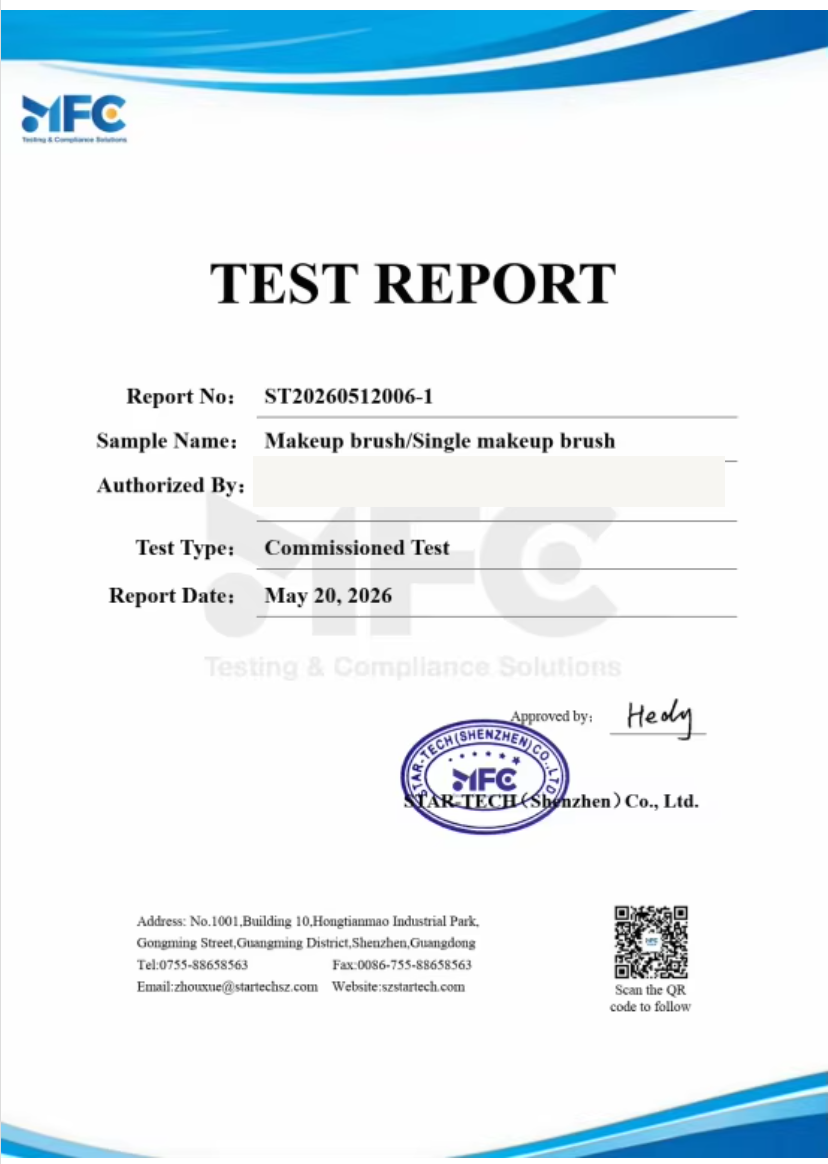
Certificates are shown as the factory received them, with the holder name withheld. Document numbers the issuer printed stay legible, so you can check them with the issuing body yourself. If your compliance file needs a copy dated inside your own audit window, ask at RFQ: we send the current certificate held by the factory that will run your order, together with the audit report where one exists.
Product compliance documentation
- EU REACH: SVHC screening documentation for fibers, coatings and packaging materials
- California Prop 65: material test reports supporting compliance assessments for the US market
- FSC: chain-of-custody documentation for certified wooden and bamboo handles
- Vegan claims: fiber composition documentation supporting vegan positioning (note: "vegan" is a claim you must be able to evidence: we supply the evidence)
- Customs & origin: HS classification guidance, certificate of origin, fumigation certificates for wooden components
These are issued per order and per material batch rather than held as standing certificates: a REACH screening report covers the materials in a specific production run, and that’s the version your importer needs.
How to verify us
Ask for the certificate numbers behind any claim on this site and check them with the issuing bodies: it takes ten minutes and we encourage it. Two things worth checking specifically:
- Does the registered entity name on the certificate match the factory making your order? If it doesn’t, ask why. This is the single most common certificate problem in this category.
- Is the certificate current? Cross-check the validity dates on the certificate against today’s date. An expired BSCI report isn’t evidence of anything.
Any supplier who hesitates at verification requests is telling you something. For our own company documents, request the register during RFQ and we will send it with the quote; for factory certificates, ask us to confirm the verification date against the issuer.

Want to verify any of this?
Ask for the audit summary, certificate register or inspection sample reports during RFQ: verification is the point.
Reply within 24 hours · MOQ from 100 pcs · Samples in 1–7 days